
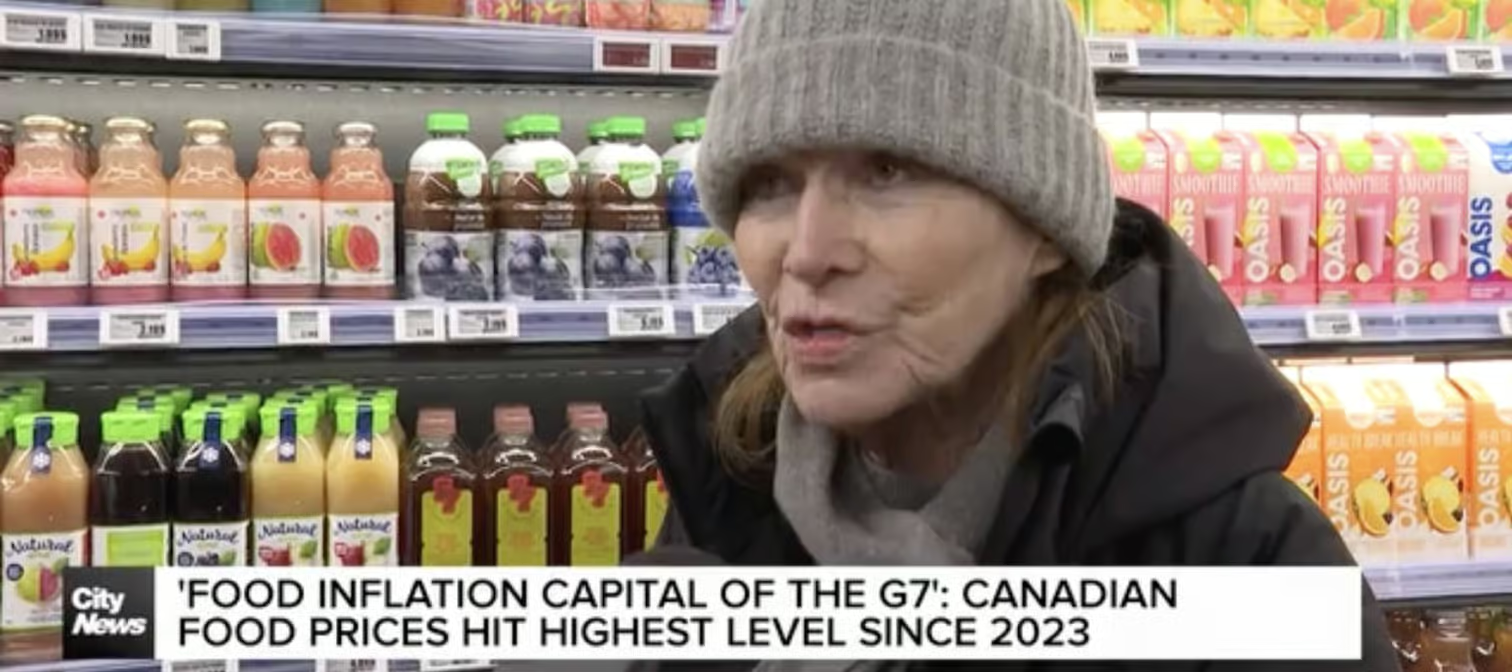
If your grocery bill has started feeling like a monthly shock, you’re not imagining it. According to food policy experts and official data, Canada now has the fastest rate of food price growth in the G7, a distinction with real consequences for households across the country — and one that will come as little surprise to anyone responsible for filling a fridge or pantry.
Statistics Canada reported that food prices climbed 6.2% over the past year, the fastest pace since 2023 (1). By comparison, U.S. food inflation was roughly half that level, based on U.S. Bureau of Labor Statistics data (2). The widening gap has led some economists to describe Canada as the “food inflation capital of the G7,” highlighting the outsized pressure Canadian families face relative to their peers in other advanced economies.
Rising grocery and restaurant costs
CityNews reported that grocery store prices rose about 5% in the past year, while restaurant meals jumped 8.5%. Many Canadians say they are noticing smaller portions and are relying more heavily on sales flyers and visiting multiple stores just to manage weekly food costs.
“I’m buying stuff I used to buy in college and I’m in my mid-30s now,” one Montreal shopper told CityNews. Another described their weekly flyer as their “bible” for finding deals.
While these coping strategies can help in the short term, they come with trade-offs. Tracking discounts and hopping between stores takes time, and cutting back on food quality can carry longer-term health implications.
What’s behind the rising prices
Several interconnected factors are driving higher food costs. Global supply chain disruptions — including shipping delays, rail bottlenecks and port inefficiencies — add costs before food ever reaches store shelves. Trade tensions and tariffs contribute additional pressure, while extreme weather and climate events affect crop yields worldwide. Geopolitical conflicts, including the war in Ukraine, for example, continue to influence commodity and fertilizer markets.
“Once these factors filter through the supply chain, consumers feel them quickly,” CityNews reported. Andrew Barclay, a senior economist at Statistics Canada, told the news outlet that “the main story for food is almost always weather,” noting that geopolitics has played a growing role more recently.
Federal policy has also affected food prices. According to StatCan, last year’s GST/HST holiday temporarily lowered the cost of certain items, including snack foods and candy, but prices rose again once the tax break ended (3).
Sylvain Charlebois, director of Dalhousie University’s Agri-Food Analytics Lab, told CityNews that without the tax break, food inflation would have been closer to 4.2%. “There’s greed, absolutely,” Charlebois said. “I do think that this is something we also need to think about with grocers.”
Costly scandals add to wallet strain
Even as inflation bites, Canadians can look back on past enforcement actions as a reminder that corporate accountability can return money to households. In 2017, major grocers and bread producers admitted to participating in a bread price-fixing scheme that inflated the cost of packaged bread for years.
Loblaw Companies Ltd. and George Weston Ltd. offered $25 gift cards as part of an early settlement, followed by a broader national class action (4). Court-approved settlements later resulted in additional cash payments, with applications accepted throughout 2025. While the application period is now closed, the program will return money to Canadians who were overcharged, illustrating how vigilance and legal recourse can deliver tangible financial benefits.
It also underscores how Canadian households can be at the mercy of market power when trust is abused — and how easily everyday consumers can be overcharged without knowing it.
What consumers can do now
Food inflation may be structural, but households can still take steps to protect their wallets. Tracking long-term price trends through StatCan data can help identify shifts beyond short-term spikes. Loyalty programs, price-matching tools and community food co-ops can offer modest savings when used consistently. Reviewing receipts over time can also reveal where spending habits have quietly changed.
Even though the bread settlement window has closed, staying aware of restitution programs and class actions remains worthwhile. In a period where groceries, housing and utilities dominate household budgets, every recovered dollar matters.
Rising food costs are not just numbers on a receipt. They represent a persistent financial challenge. Understanding why prices are climbing — and where accountability exists — gives Canadians a clearer path to navigating the pressure with more control over their money.