

District must upzone certain neighbourhoods by end of year or province could do it for them
West Vancouver’s Ambleside neighbourhood is one of three areas the provincial government wants the district to densify. (Martin Diotte/CBC)
Of all the B.C. cities targeted to increase housing development, West Vancouver may have the most contentious relationship with the province — and the mayor says he is refusing to back down.
As a provincially mandated Dec. 31 deadline looms over the city to approve more housing density in three neighbourhoods along Marine Drive, West Vancouver Mayor Mark Sager says he’s fundamentally opposed to the province’s approach.
“I just think picking arbitrary dates, arbitrary numbers, and trying to force their vision on local communities is fundamentally wrong,” Sager said.
But if the district doesn’t do what the province wants, the province has the authority to override the district and densify where it wants.
West Vancouver was one of 10 municipalities on the province’s so-called “naughty list” in 2023.
It was nearly last in meeting its targets for new housing, with only 172 homes built between Oct. 1, 2023, and Sept. 30 this year. It didn’t reach even 40 per cent of its goal.
It was nearly last in meeting its targets for new housing, with only 172 homes built between Oct. 1, 2023, and Sept. 30 this year. It didn’t reach even 40 per cent of its goal.
How many new housing units are there in the 10 municipalities the B.C. government put on their 2023 watch list?
But Sager said he refuses to abide by the provincial directives because he’s opposed to the process, arguing it should be based on housing approvals rather than completions, and municipalities should have more time to come to local decisions.
B.C.’s new housing targets list draws mayors’ frustration
“For the minister sitting in Victoria who doesn’t know really anything about our community, doesn’t know about the infrastructure, doesn’t know about our road systems … to come in and slap down regulations that don’t work — I’m not going to sign that.”
LISTEN | This is Vancouver takes a deeper dive into the fight between West Vancouver and the province over the municipality’s housing policies:
West Vancouver is falling short of its mandated housing targets — and the province is warning it might take action. The CBC’s Justin McElroy joins Gloria Macarenko to talk about what’s behind the standoff and what it means for housing supply in Metro Vancouver.
‘None of this is a surprise’: minister
Housing and Municipalities Minister Christine Boyle said she is “stubbornly hopeful” that West Vancouver will allow more affordable homes in the city.
“That really is the focus of all of our shared work on housing,” she said.
-
- B.C. steadfast on housing targets despite municipal pushback
- Here are the 10 municipalities B.C. has put on a watch list for housing targets
But she doesn’t seem to be backing down on the threat to override municipal bylaws.
“I don’t want that to have to be necessary … but if we get to the place where we need to override these rules, I will feel confident that we have been clear in our communication.”Boyle said the Dec. 31 deadline isn’t arbitrary, noting the province has worked with both council and West Vancouver staff on the directives.
But she doesn’t seem to be backing down on the threat to override municipal bylaws.
“I don’t want that to have to be necessary … but if we get to the place where we need to override these rules, I will feel confident that we have been clear in our communication.”
Boyle said the Dec. 31 deadline isn’t arbitrary, noting the province has worked with both council and West Vancouver staff on the directives.
“There’s been lots of time. None of this is a surprise,” she said.
WATCH | West Vancouver rejects B.C.’s deadline to rezone neighbourhoods for more housing:
The B.C. government has threatened to take over West Vancouver’s housing policy if they don’t approve more density by the end of the year — and as Justin McElroy explains, the mayor seems ready to call the province’s bluff.
Ambleside plan problems
One of the most contentious provincial directives has been the Ambleside local area plan.
Council has been deadlocked in a 3-3 vote split for months, as the mayor owns property in the area and has recused himself from voting.
Coun. Nora Gambioli, the longest-serving council member, believes the city hasn’t built enough housing.
“We have not been meeting the provincial targets and we haven’t even been meeting our own targets,” Gambioli said.
She said she’s supportive of the Ambleside plan presented by staff in May, which would focus on increased heights of up to four storeys through most of the Marine Drive corridor.
“We’re not in a fight directly with the provincial government on a lot of this. We’re actually in a fight between ourselves in terms of the politics here.”
And while the province’s appointed housing adviser branded West Vancouver as “an affluent enclave resistant to change” in his report, Gambioli said that impression erases many residents who want to see the city grow.
One of those pro-development locals, Maureen O’Brien, executive director of the Ambleside and Dundarave Business Improvement Association (BIA), said more density will attract more businesses — the kinds that residents want: mom-and-pop-type businesses like bookstores, clothing stores, breweries.
“No one’s going to come and do that if we don’t give them the space to do that,” O’Brien said.
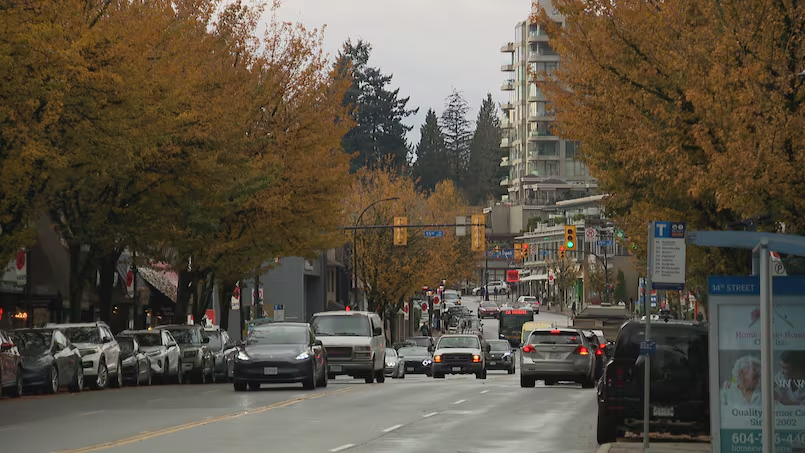
Ambleside is one of the West Vancouver neighbourhoods where the B.C. government wants to see increased housing density. (Martin Diotte/CBC)
O’Brien said there have been 33 studies on Ambleside in the past 79 years.
“There has been such great engagement that I think it’s disrespectful to those that gave their input to not push this forward.”
Coun. Peter Lambur, however, has opposed the Ambleside plan.
He said increased height and density would impact the character and ambiance of the Ambleside Village and advocated for an incremental rather than transformative process.
“There’s the fear of losing the, you know, charm and intimacy of the area as it is or wants to be in the future.”
Lambur said new development could increase the price of rent for local businesses.
As for West Van’s “NIMBY” attitude, Lambur said it’s incorrectly characterized as a kind of selfish or self-protective mindset.
“Sort of ‘my way or the highway,’ but I don’t believe that at all. And I don’t believe that people should be ashamed of the word NIMBY — it’s what the development industry has, I think, successfully characterized it as.”
More opposition to come, hopes mayor
While many B.C. mayors have also shared their frustrations with the province’s multiple pieces of legislation forcing higher levels of development and density than in the past, most have acquiesced.
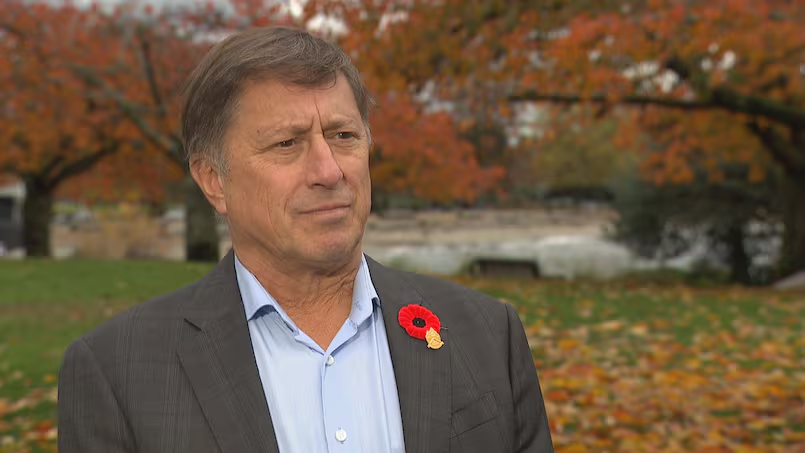
West Vancouver Mayor Mark Sager says he is opposed to the province’s approach to housing targets. (Martin Diotte/CBC)
But Sager said he’s not worried about opposing the higher level of government.
“If I was standing alone without any of the other communities supporting us, I’d be concerned. But you will hear, you will see that all, with one exception, of the other mayors of Metro Vancouver are standing firmly with us.”